8 High School Chemistry Classroom Must-Haves That Make Teaching Easier
I don’t know about you, but I love things that make my life as a high school chemistry teacher easier and things that are useful in teaching and engaging my students. Sometimes, you don’t know about cool things until someone else mentions them. I usually check out blogs and Instagram to find cool products and ideas.
In this post, I am going to list the items that are a must have in my high school chemistry class. These are some of my current favorite things and supplies for high school chemistry classes, including both teacher-oriented or student-oriented items and ideas.
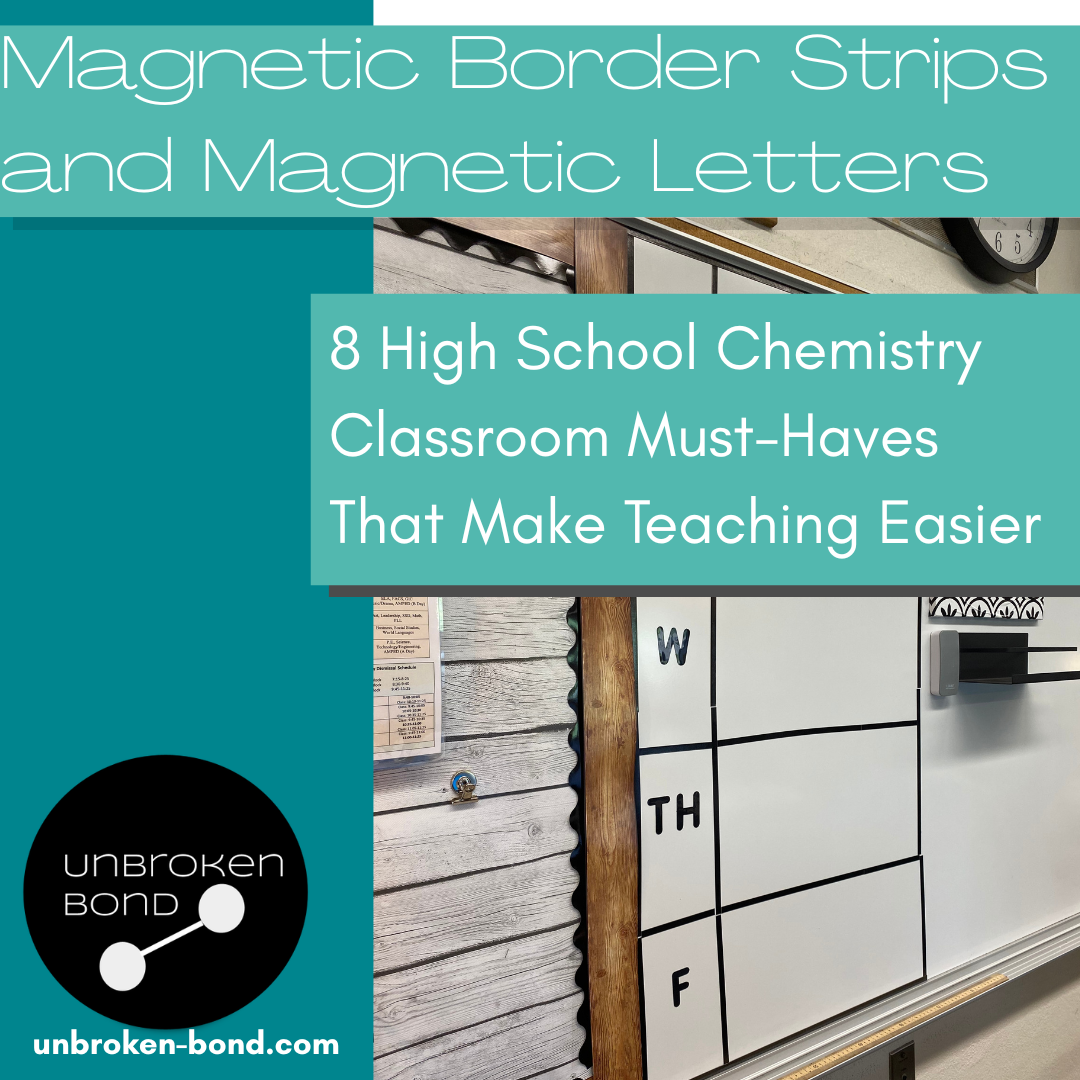
Magnetic Border Strips and Magnetic Letters
Having a place where students can easily locate important information is a system you don’t want to miss in your classroom. Or maybe you also need to have your learning targets posted like I do. Once I found magnetic borders, I never looked back. They come in all sorts of styles and widths. There is no residue, like there would be with painter’s tape. They’re easily movable and can be repurposed throughout the year.
I usually set up a grid that contains magnetic letters for the courses I teach, with one course per grid. This allows me a space to write learning targets and to post announcements, such as when upcoming tests might be or when they need appropriate lab wear.
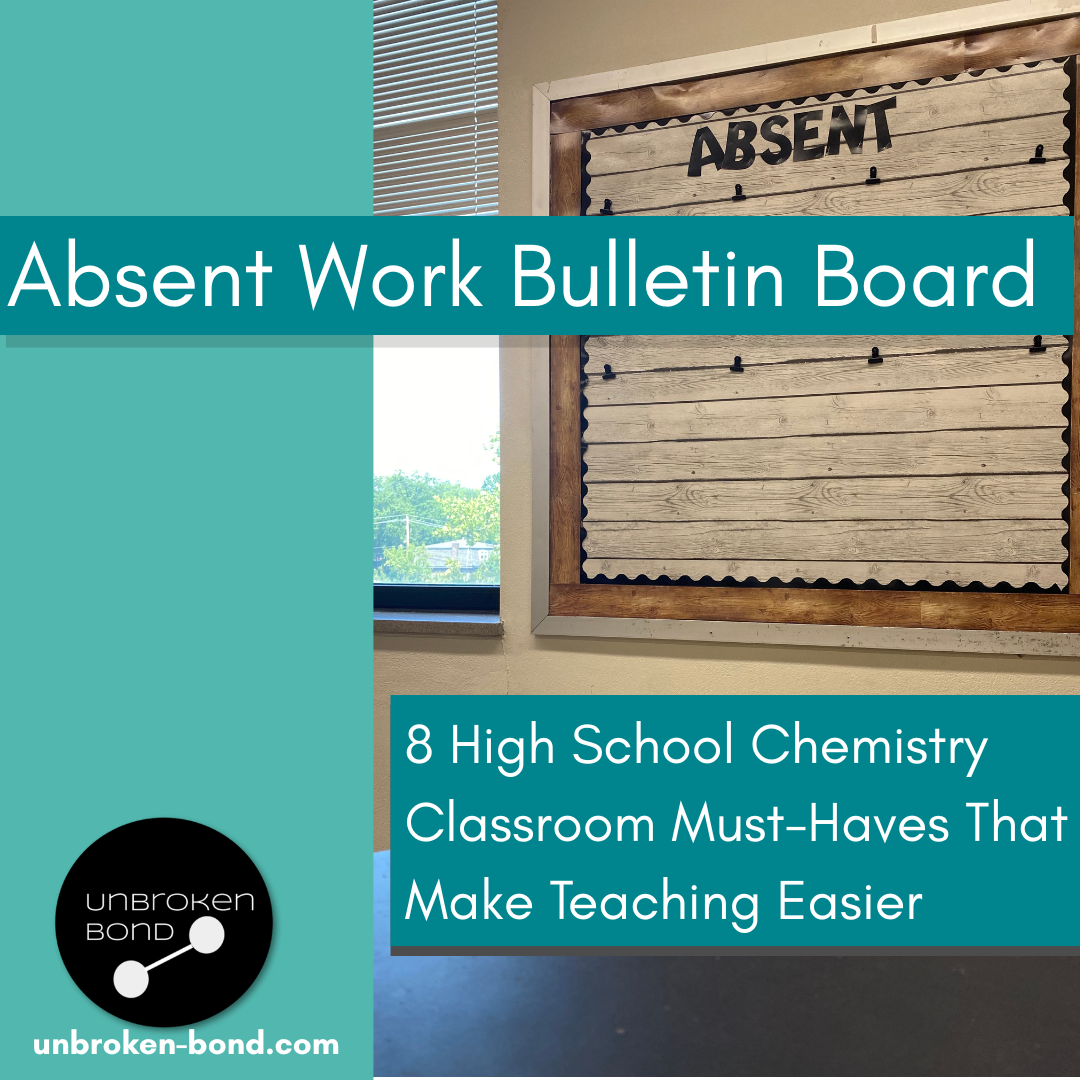
Absent Work Bulletin Board
There are a lot of options for setting up an absent work system. Many people use bins with folders. Personally, I didn’t think I would keep up with emptying it or be good about keeping it in any sort of order. For me, this absent board has worked great. I add notes and worksheets to a clip with the students’ name on it. They can come in, grab their papers from the absent board and not accidentally grab something they don’t need or papers that are not their papers. Plus, if a student fails to grab their papers, I can ask them about it a few days later, and prompt them to grab it from the board.
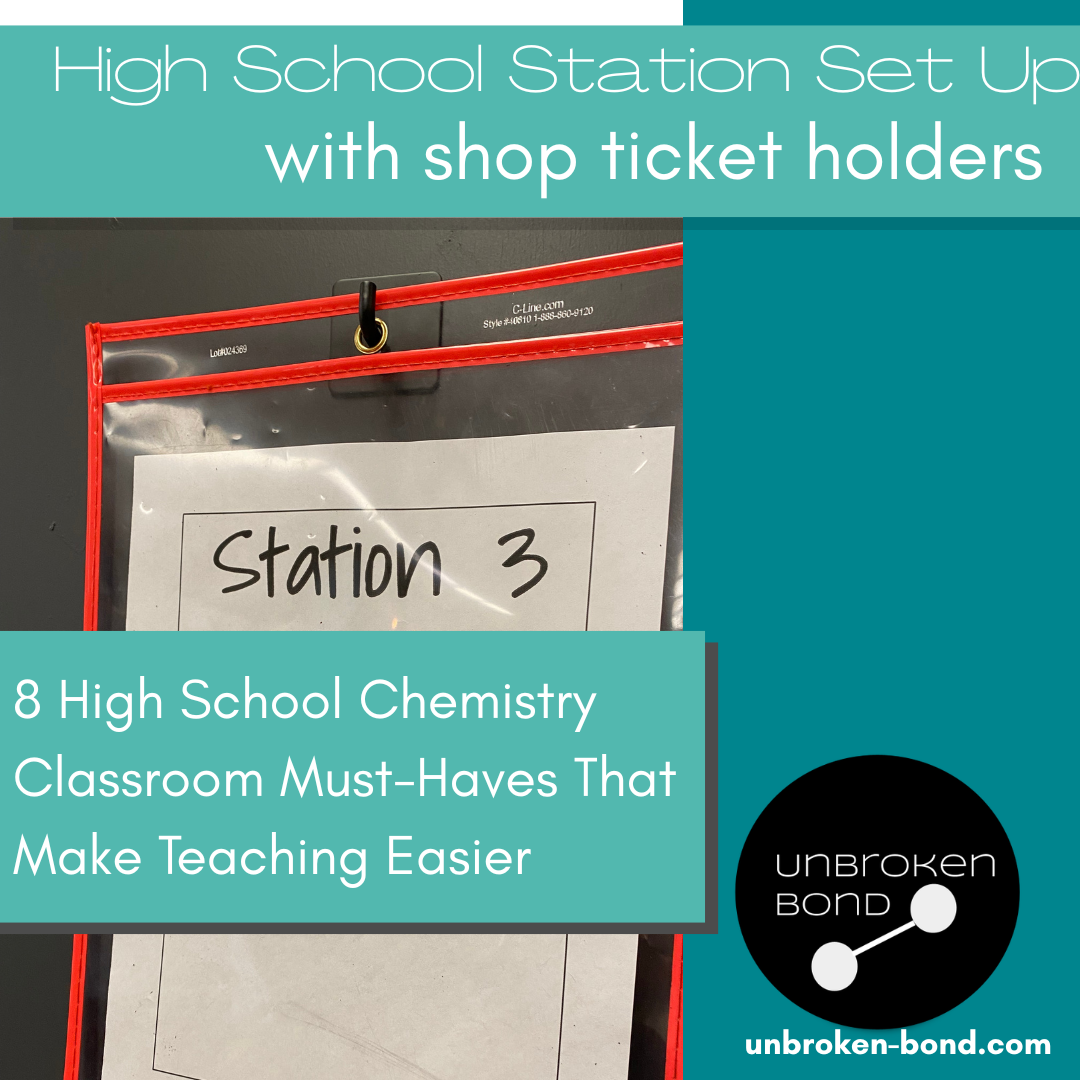
High School Station Set-Up with Shop Ticket Holders
I have very little free wall space in my classroom. There’s a lot of cabinets and drawers. I used to tape stations, write the rooms, and more to the cabinets. But when I would take it down, tape residue was left behind on the cabinets. After I painted my cabinets to freshen them up, I decided I wouldn’t use tape again, and that I would find a permanent solution that wouldn’t damage the cabinets. I added adhesive hooks that I could hang shop ticket holders from. When they’re not in use, I simply take the shop ticket holders off, leaving the hooks behind. Plus, it makes it easy to change out content. If I have an AP Chemistry activity up, but I’ve got a chemistry class coming up, I can quickly change out the shop ticket holders.
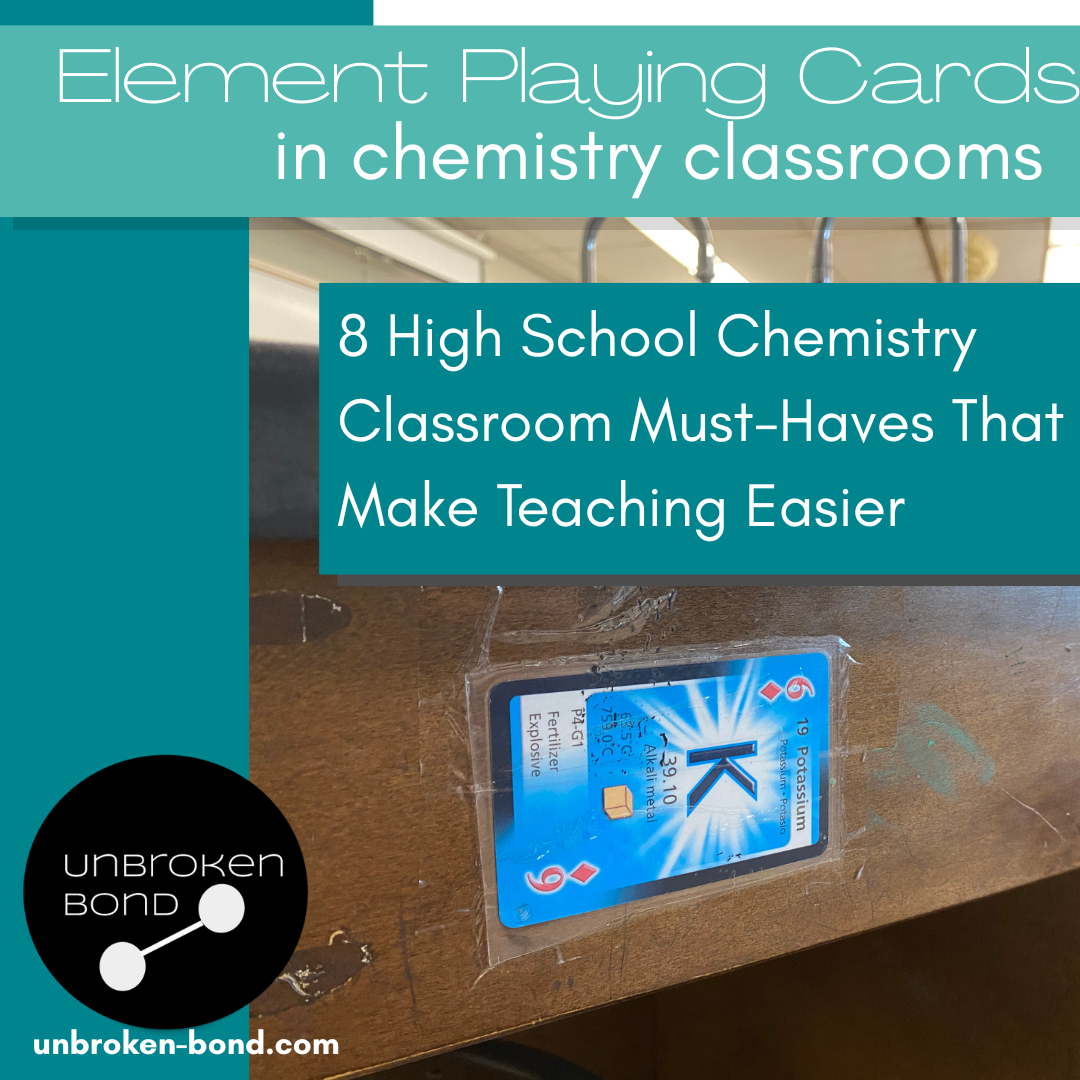
Element Playing Cards
This last item is more of a classroom management system. I have four seats at each of my tables. I labeled each seat with a specific type of card. For example, for all of the seats facing the windows, I taped an element card from the alkali metal group. For the 4 seats, I used the categories of alkali metals, alkaline earth metals, noble gases, and transition metals. I have a random picker that I use to pick a seat. If that seat gets picked, each student with that category will perform a task. For example, I might spin the wheel and the noble gases might be chosen. The noble gases may be responsible for putting something away, passing something out, or retrieving supplies for their table. I also use the cards to pair students for various activities. I might say something like “the alkali and transition metal are going to partner up, while the alkaline earth metal and noble gas will pair up.” This allows me to randomize partners. These periodic table cards have been a great addition to my classroom management routines. Plus it saves time when students complete tasks, and I no longer pass out papers, as an example. If you want to read more about using these cards in your classroom, click here.
Lab Clean Up Kits
Training students on how to clean glassware can be tricky. Especially if materials aren’t readily available for students to grab. That’s where a good lab clean up kit or caddy can come in hand. These are some of the things I like to put in my lab clean up caddies:
Soap
Distilled water bottles
Hand soap
Flask brushes
Bottle brushes
I might also include test tube brushes. This depends on the class. I have lab drawers in my classroom that I check out to AP Chemistry and Honors Chemistry students, and there are two different test tube brushes in each drawer. You can read about how I set up my lab drawers here. But if I have a regular chemistry class that does not get drawers, I would also include test tube brushes, usually in 2 sizes.
If it’s a regular chemistry class and we need to filter a precipitate, I might also include an Erlenmeyer flask, funnel and filter paper.
Distilled Water Systems
If you use a lot of distilled water, having a set up in place for distilled water is imperative. Firstly, you need distilled water bottles that students can easily grab. I used my Cricut and cut vinyl Lewis structure models of H₂O, which I placed on each bottle. The students know where these bottles are located, and can grab one as needed.
As for the distilled H₂O itself, you need to have a plan in place for restocking, as well as where it will be stored. I recommend a carboy to store your distilled H₂O. For my AP Chemistry classes, I find that I use it enough that I’m not concerned about the quality of the H₂O in the carboy. I do however dump it at the end of the year if there’s any left.
You can buy gallons of distilled H₂O at many grocery stores and suppliers, and I used to do that. I would buy 10 at a time, and have to carry them across the building and up to the 2nd floor. There’s nothing wrong with buying these jugs, but I got tired of lugging around those jugs all the time. We briefly had a working wall distiller, which was great. But it’s no longer functional. Right now, I rely on a tabletop distiller, which works well enough for my purposes. I start the table top distiller in the morning when I know I need to make distilled water, and it’s done after about 4 hours. Then it gets poured into one of the carboys. I repeat this morning process until the carboys are full.
Task Card & Activities Storage
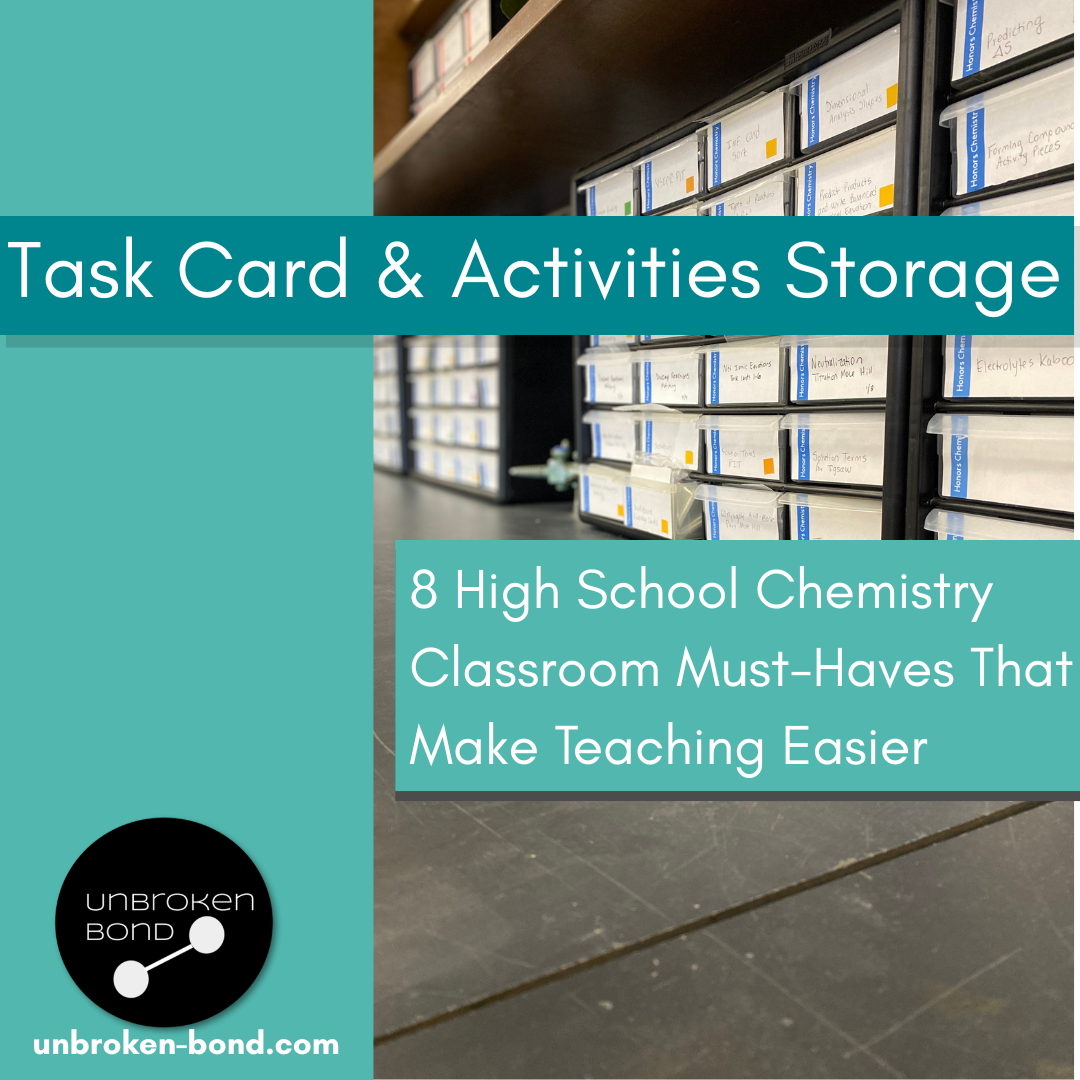
I like an organized classroom, so organizing task cards and activities is a must for me. For task cards or other small card-sized activities, such as WAR, I love the toolbox drawers. I have several of them at this point, which AP Chemistry sets separated from regular/Honors Chemistry level material. They are labeled on the front, and placed in (mostly) chronological order, which makes it easy to find what I need. It also makes it easy to grab something quickly if I find myself with a few extra minutes and needing another activity.
For my letter-sized (or larger) activities, I’ve got these stored in a cabinet. The letter sized activities go in these Target Brightroom storage bins, and inside the bin, each set for a partner is likely in a mesh zipper pouch. It’s easy to pull the bin out when needed, and easy to say “each partner needs one of these pouches.” Makes transitions smoother and reduces some of the chaos of disorganization.
Accessible Storage of Lab Equipment
As mentioned previously, I store a lot of lab equipment in my lab drawers, which get checked out to AP Chemistry and Honors Chemistry students. For regular chemistry students, I place what equipment is needed in a bin for each table, so that it is readily accessible.
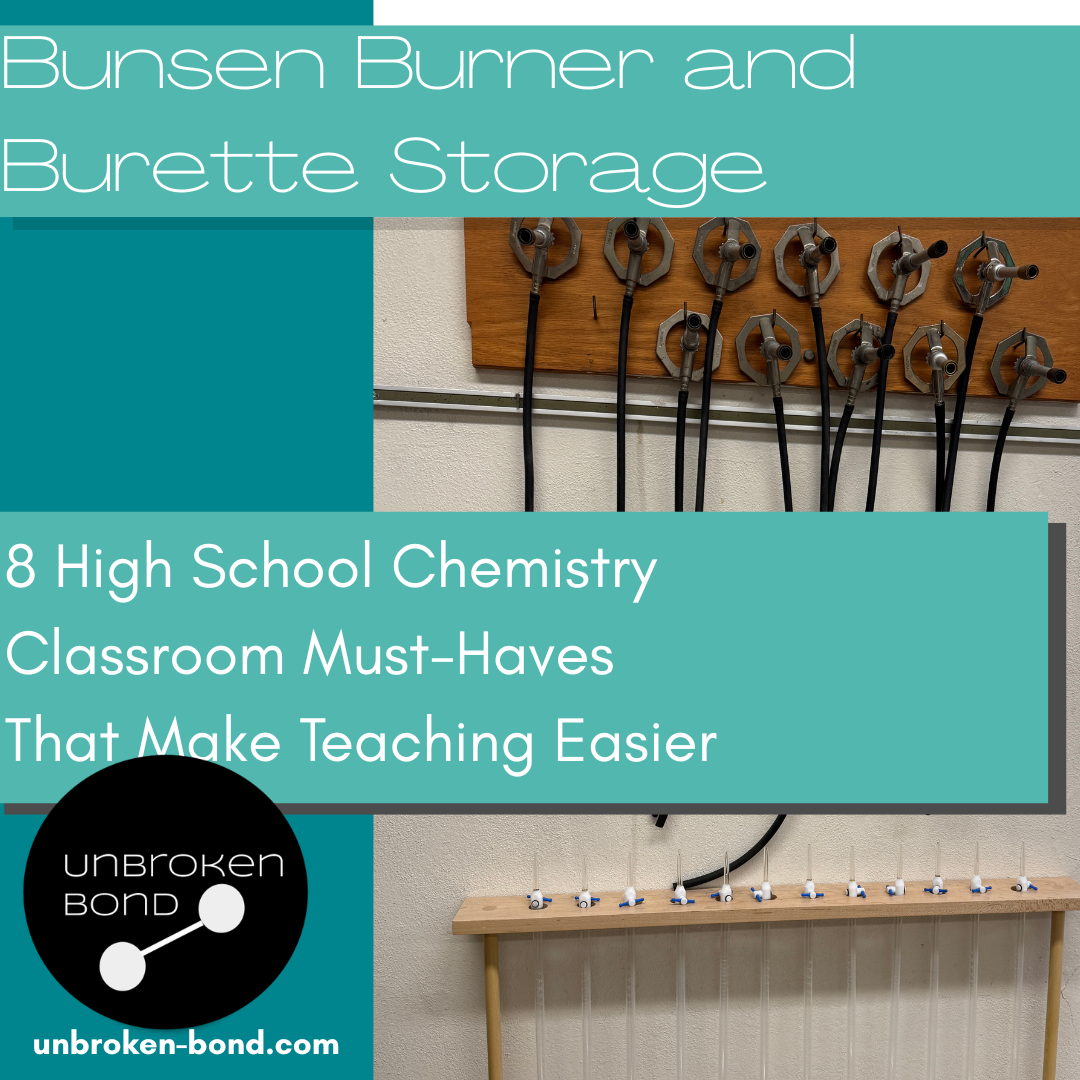
But there are some pieces of equipment that doesn’t fit in a lab drawer or I might not have 72 of them, which is the number of lab drawers I have. The equipment used less frequently is usually stored in a cabinet until I need it. But there are 2 storage systems I use that I love.
The first is a board with hooks to hang Bunsen burners from. These are used fairly often, and because it is almost more of a visual display in the room, it’s easy for students to find. Could they be stored in a drawer, sure. But then I’d have to open the drawer so students know where they are, and that’s just less efficient from what I’ve seen. This board was in my room when I started at my current high school in the 2013-2014 school year, but I’m sure if you know someone handy, they could make it for you. Or maybe you’re handy?!
The second that I’ve grown to love is a burette holder. I had a box of burets in a cabinet, but it was on the highest shelf behind other stuff. Every year when I had to get them out, I would be annoyed. And then I’d have to do it again in a few weeks for another AP Chemistry lab. I found a burette holder on Flinn’s website, and had it attached to the wall under my Bunsen burners. It’s great. I don’t have to struggle to pull them out every year and I don’t have to constantly repeat myself about where they are. They are clearly visible in the room and students know where to grab them from when we need them.
The best classroom supplies and systems are the ones that make everyday routines just a little bit easier. Whether it’s giving students a clear place to find absent work, making lab supplies more accessible, or organizing activities so I can grab them quickly, each of these systems helps my chemistry classroom run more smoothly.
You definitely don’t need to add everything at once! Start with one area of your classroom that tends to cause frustration or take up too much of your time, and look for a system that can simplify it. Sometimes a small change in how you organize your classroom can make a surprisingly big difference in how independently your students can work. And how much you have to manage yourself.
Thanks for reading! Do you have any systems you love?! Let us know on Instagram.