How to Teach Periodic Trends: Activities that Build Student Reasoning
Periodic trends are one of those chemistry topics where students can look like they understand the content before they really do.
Ask which element has the larger atomic radius, and many students can answer correctly. Ask them why, and you may hear “because atomic radius increases down and to the left.”
They know the trend, but they aren’t actually explaining the chemistry.
When I teach periodic trends, I want students to move beyond memorizing arrows and start using atomic structure to explain why the trend occurs. That means connecting effective nuclear charge, shielding, energy levels, distance from the nucleus, and attraction between charged particles to properties like atomic radius and ionization energy.
But I don’t expect students to make all of those connections immediately. Instead, I like to scaffold the reasoning and gradually take those supports away.
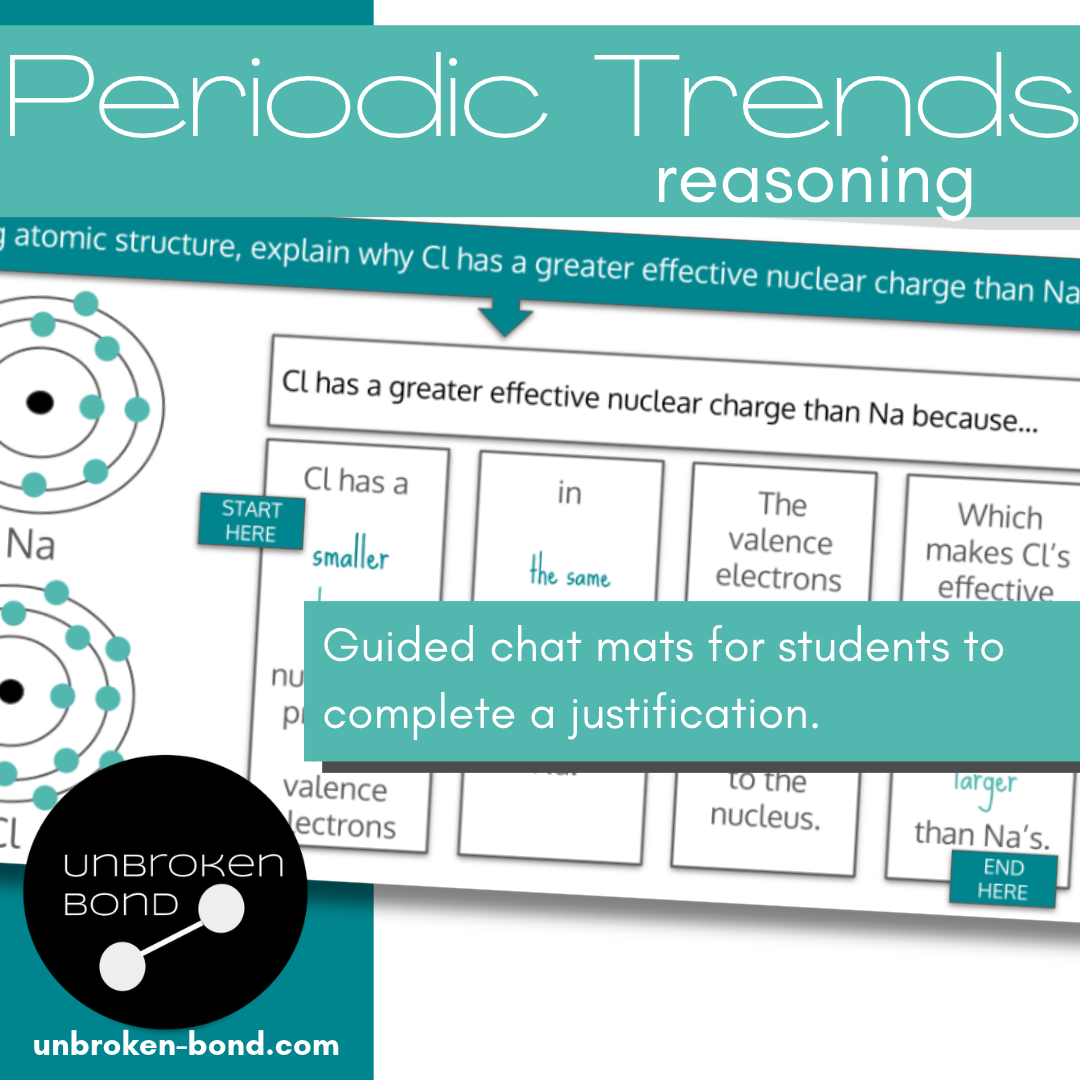
Start with Guided Periodic Trend Explanations
A complete periodic-trend explanation requires students to connect several ideas at once. For example, when comparing Mg and Al, students should be able to follow a reasoning chain like:
Smaller effective nuclear charge → less attraction for valence electrons → electrons remain farther from the nucleus → larger atomic radius
Rather than immediately asking students to write that explanation themselves, I like to break it into smaller decisions.
Students might first choose whether the effective nuclear charge is larger or smaller, then whether the valence electrons are more or less attracted to the nucleus, and finally, whether those electrons would be closer to or farther from the nucleus.
Students are still doing the reasoning, but they aren’t also struggling to figure out how to put the entire explanation into words.
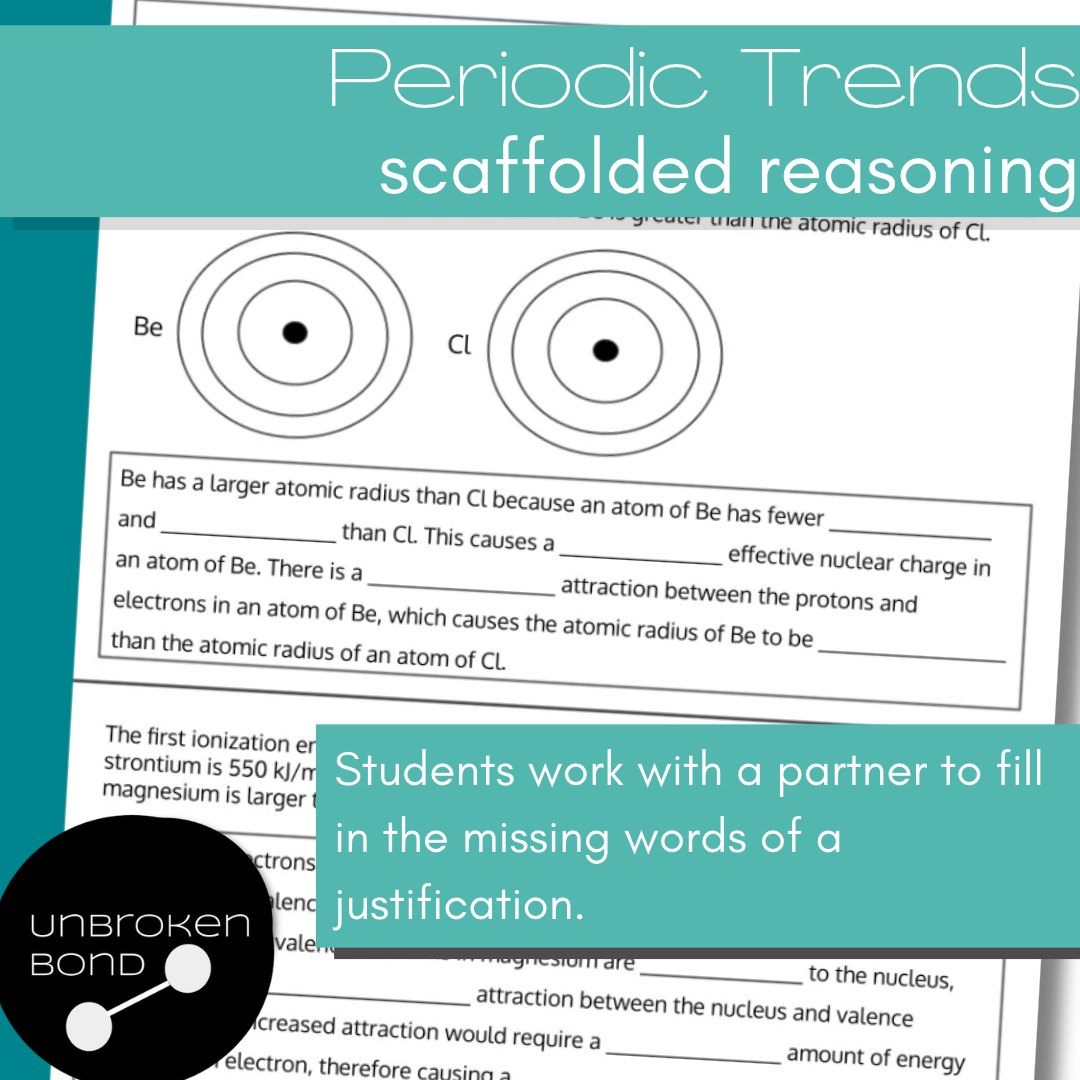
Gradually Take Away the Scaffolding
Once students understand the reasoning process, I start removing some of that support.
Partner chat mats are one way to do this. Instead of choosing between options, students fill in the missing pieces of an explanation and discuss their reasoning with a partner.
For example, students could compare the ionization energies of Mg and Sr, thinking about the energy levels of their valence electrons, their distance from the nucleus, the resulting attraction (or lack thereof), and how much energy is required to remove an electron. The sentence structure is still there, but students have to think about more of the chemistry.
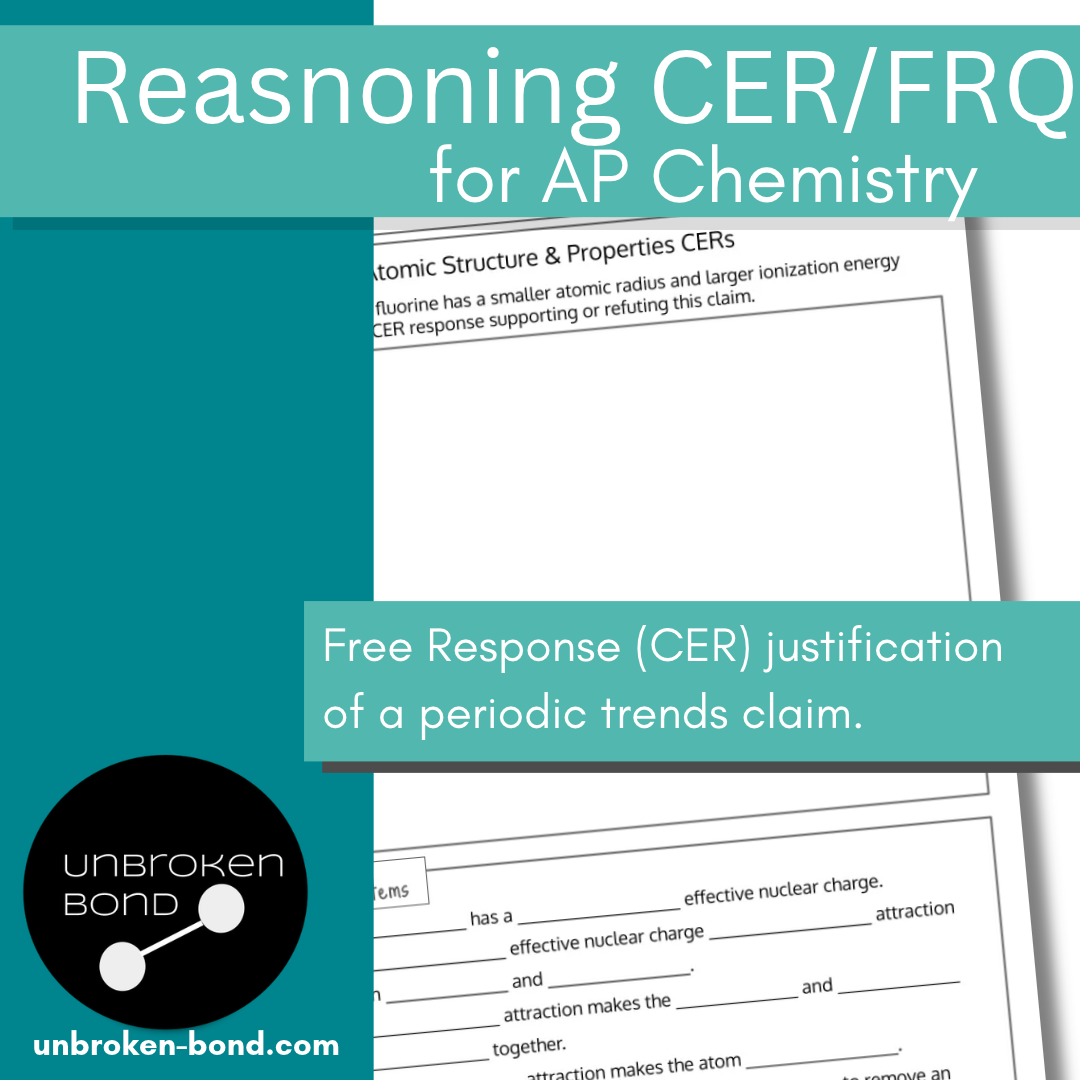
Move into CERs or FRQs for Independent Explanations
Once students have practiced building explanations, CERs and FRQs are the great next step. Students are given a claim to support or refute. For example, a student claims that fluorine has a smaller atomic radius and larger ionization energy than lithium.
Students then have to turn their understanding into a complete written explanation. You could still provide sentence stems as an optional scaffold. For this example, those sentence stems could prompt students to consider effective nuclear charge, attraction between the nucleus and valence electrons, atomic radius, and the energy required to remove an electron.
The optional sentence stems could provide support without writing the explanation for them. For students who are ready to write on their own, remove sentence stems and challenge them to support or refute the claim on their own.
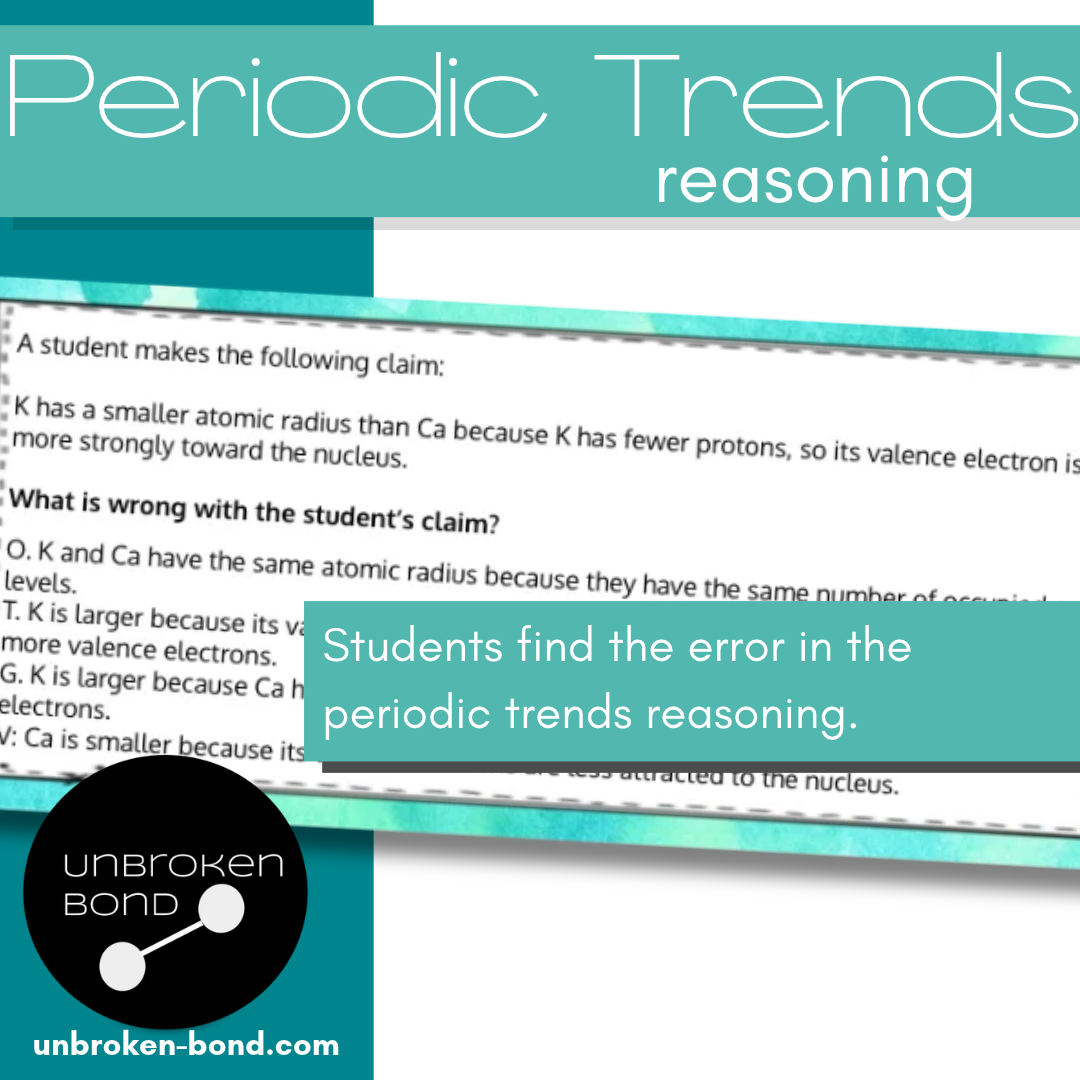
Ask Students to Find the Error
Another way to support periodic trend reasoning is with error analysis.
Instead of asking students for the trend, give them an incorrect student explanation and ask “What’s wrong with this reasoning?”
For example, a student might claim that K has a smaller atomic radius than Ca because K has fewer protons. To correct the explanation, students need to recognize that Ca has a stronger effective nuclear charge and therefore attracts its electrons more strongly, which would make Ca’s atomic radius smaller than the radius for K.
Error analysis is helpful because students have to identify the misconception rather than simply recognize the correct answer.
Add Periodic Trend Card Sorts and Games
Not all periodic trend practice needs to involve writing. I also like activities that give students repeated opportunities to compare elements.
One option is an AP Chemistry Ordering Periodic Trends card sort. Students order several elements according to a periodic property and then explain the elements at the ends of their order. I like that extra explanation piece because students can’t stop at “this is the order.” They have to explain why.
Periodic trends WAR is another way to get in lots of comparisons without a worksheet. Students repeatedly compare element cards to determine which one wins based on a particular property.
From Memorizing Periodic Trends to Explaining Them
Ultimately, I want students to see periodic trends as more than arrows on a periodic table. A progression that works well is guided reasoning to partner explanations to CERs and FRQs to error analysis and application.
The question I keep coming back to is not “do you know which way the trend goes?” but it’s “Can you explain why?” When students can connect effective nuclear charge, shielding, energy levels, and attraction to the trends, they have a model that they can actually use, even when the question isn’t one they’ve seen before.
Thanks for reading! Happy teaching!