Chemistry Game Board Spinners: A Low Prep Partner Game
If you’ve ever wished your chemistry review felt more like a game and less like a worksheet…this is it.
Game board spinners are one of my favorite ways to transform routine chemistry practice into something interactive, competitive, and engaging.
Instead of handing students a list of problems, they:
Spin one wheel.
Spin another wheel.
Analyze the scenario.
Justify their answer.
Move on the board.
It’s structured. It’s content heavy. And it keeps students talking about chemistry.
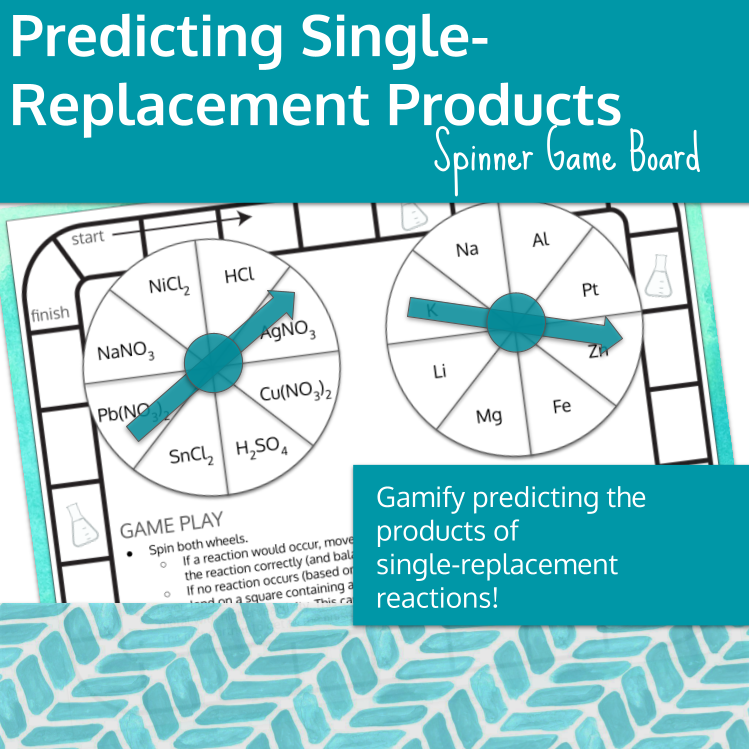
Today I’m sharing how I use two-wheel spinner game boards to practice content like predicting single-replacement reactions and determining limiting reactants.
What are chemistry game board spinners?
A chemistry game board spinner activity combines:
Two content wheels
A board game path
Partner collaboration
Targeted chemistry practice
Students spin both wheels to generate a problem scenario. Then they analyze the chemistry, determine the correct answer, and then move forward (or backward!) on the board based on their answer.
Because the problems are generated randomly through spinning, students get built-in variety and repeated practice without it feeling too repetitive.
Why use two spinner wheels in chemistry?
Using two wheels increases rigor immediately. Instead of a single prompt, students combine two variables.
For example:
Wheel A: reactant A quantities
Wheel B: reactant B quantities
Reaction given: 2A + B2 → 2AB
Students must determine:
Which reactant is limiting?
What is the theoretical yield?
Is the ratio stoichiometric?
This gets students applying concepts instead of just memorizing.
Example 1: Predicting Single Replacement Reactions
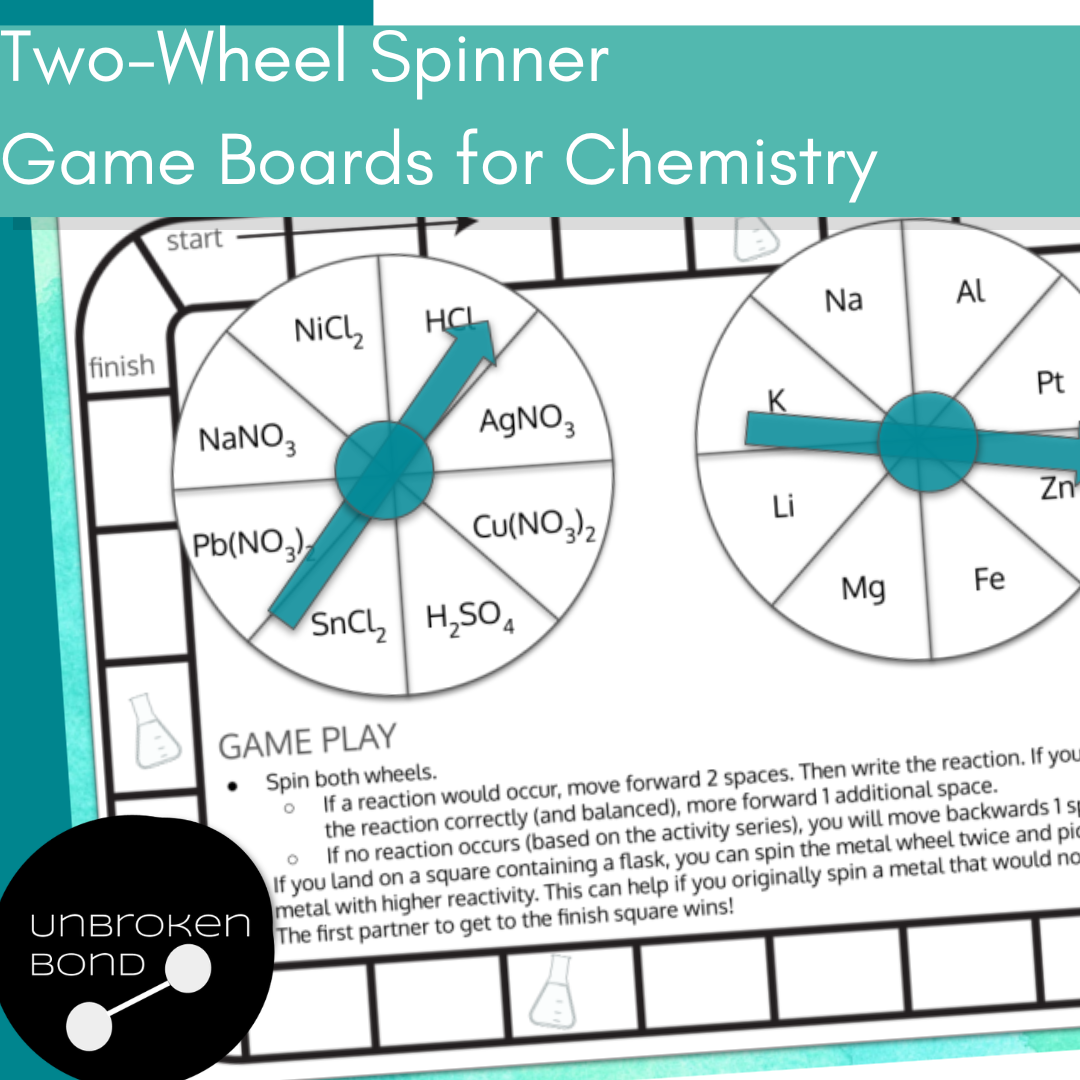
In this activity, students spin to determine the reacting metal and the ionic compound.
Then they will:
Use the activity series
Predict whether a reaction occurs
Write and balance the equation if it does occur
Because it’s game based, students repeatedly practice checking the activity series. But it feels competitive rather than procedural. This makes it perfect for practice before a quiz, reinforcement after direct instruction, small group remediation, and early finisher work.
Example 2: Determining Limiting Reactants
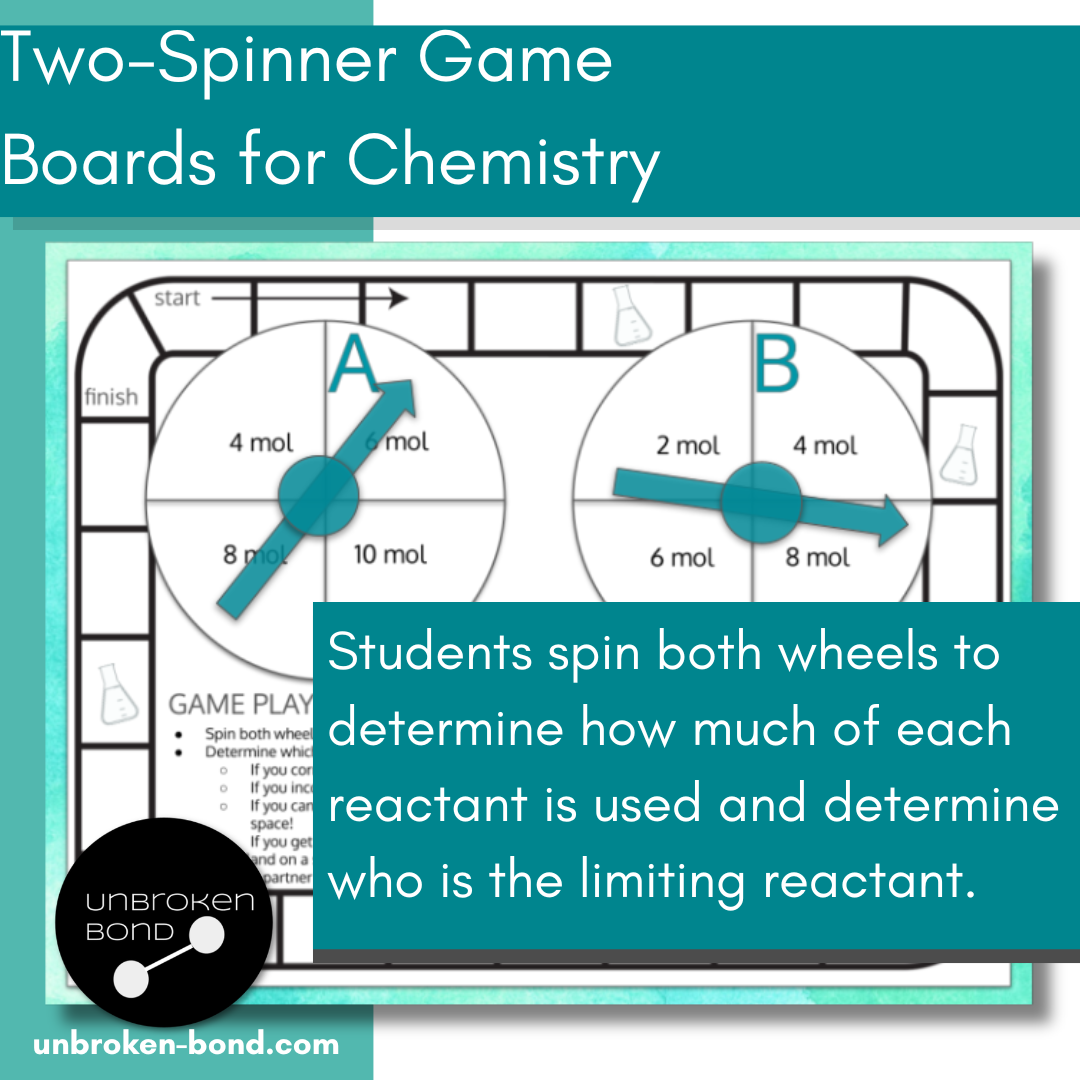
Another version uses two wheels to determine the starting moles of Reactant A and Reactant B. The game board provides a reaction, such as 2A + B2 → 2AB.
Wheel A might land on:
4 mol A
6 mol A
8 mol A
10 mol A
Wheel B might land on:
2 mol B2
4 mol B2
6 mol B2
8 mol B2
After spinning the wheel, students must:
Determine the limiting reactant
Calculate theoretical yield
Identify if the ratio is perfect
Move accordingly on the board
Game play could include moving forward for successfully determining the limiting reactant, gaining an extra space if properly determining the theoretical yield, and moving backward if incorrect.
Limiting reactants suddenly might become a little less intimidating.
Why Game Board Spinners Work Well in Chemistry:
They promote academic conversation.
Partners must agree before moving. This means students explain “wait, divide by the coefficient,” or “is this metal above copper on the activity series?”That reasoning conversation is where learning happens.
They provide built-in differentiation.
You can adjust wheel numbers for easier or harder calculations. You could use whole numbers for standard chemistry or decimals for honors.
You have the same structure but can modify it for different levels of rigor.
They increase engagement without a ton of extra prep.
To set up one of these game boards, you need a printed board, two spinners, game pieces, and maybe an answer key. You don’t have to set up stations or tech, and there’s no complicated instructions. Students understand game boards and you spend less time explaining.
They reduce passive practice.
Traditional worksheets may result in one student doing all the work, quiet copying, and minimal discussion. Game board spinners increase the likelihood of active participation. Movement depends on reasoning, so students are more invested in getting the answer.
How to create your own chemistry spinner game boards.
Step 1: Choose a focused skill.
Step 2: Build two complementary wheels.
Wheel A: One variable.
Wheel B: A second variable.
For example, the wheels could contain reactant amounts, metal and compound pairings, acid and base pairings, and more. The magic is in combining the two.
Step 3: Add movement incentives.
Game mechanics make it engaging.
Forward for correct answers.
Back for incorrect answers.
Bonus spaces for deeper reasoning.
Extra turn squares.
Step 4: Require justification.
Ask students to justify before moving their game piece.
Final Thoughts: From Single-Wheel to Two-Wheel Chemistry Games
Students need repetition. They need stoichiometry reps. They need activity series reps. They need reaction prediction reps. But they don’t need another packet.
Two-wheel chemistry game board spinners keep rigor high while making practice interactive. When students are spinning, calculating, debating, and racing to the finish, they're engaged in meaningful chemistry thinking-and not just passive completion.
And if you love this format, it pairs perfectly with my single-wheel spin and cover activities. If you haven’t read that post yet, you can check it out here:
👉 How to Gamify Worksheets in Chemistry with Spin and Cover
While spin and cover uses one wheel and focuses on quick-answer identification, these two-wheel game board spinners increase complexity by combining variables and layering in multi-step reasoning.
Think of it this way:
Spin and cover → quick concept checks + structured repetition
Two-wheel game board spinners → applied reasoning + multi-step problem solving
Both formats promote academic discussion, increase engagement, reduce worksheet fatigue, and keep prep simple.
The structure may change, but the goal stays the same. Make chemistry practice interactive, rigorous, and actually enjoyable. Because when students are moving pieces instead of just filling in blanks, they’re far more likely to stay engaged, and far more likely to understand the content.
Thanks for reading!

Not ready to make your own? Check out these two-wheel game board spinners for chemistry available in my TPT store by clicking on the image below.