Multiple Choice Practice for High School Chemistry with Crack the Case Puzzles
Do your students struggle with multiple choice questions, especially at the AP Chemistry level? Mine do, and I’m always looking for more ways to give my students more multiple choice practice. One of the ways I give my students multiple choice practice is with a question trail, which you can read about here. But I wanted additional practice beyond my questions trails, so I created a multiple choice crack the case puzzle for one of my units-and have since used this format again.
What are crack the case puzzles?
Basically, students just have some code they have to “break.” In some puzzles, you might have three or four codes, and then a logic puzzle that gets used by the students to determine the final code to “crack the case.” But because these were multiple choice questions and not numerical answers, I needed to modify the format.
Multiple Choice Crack the Case
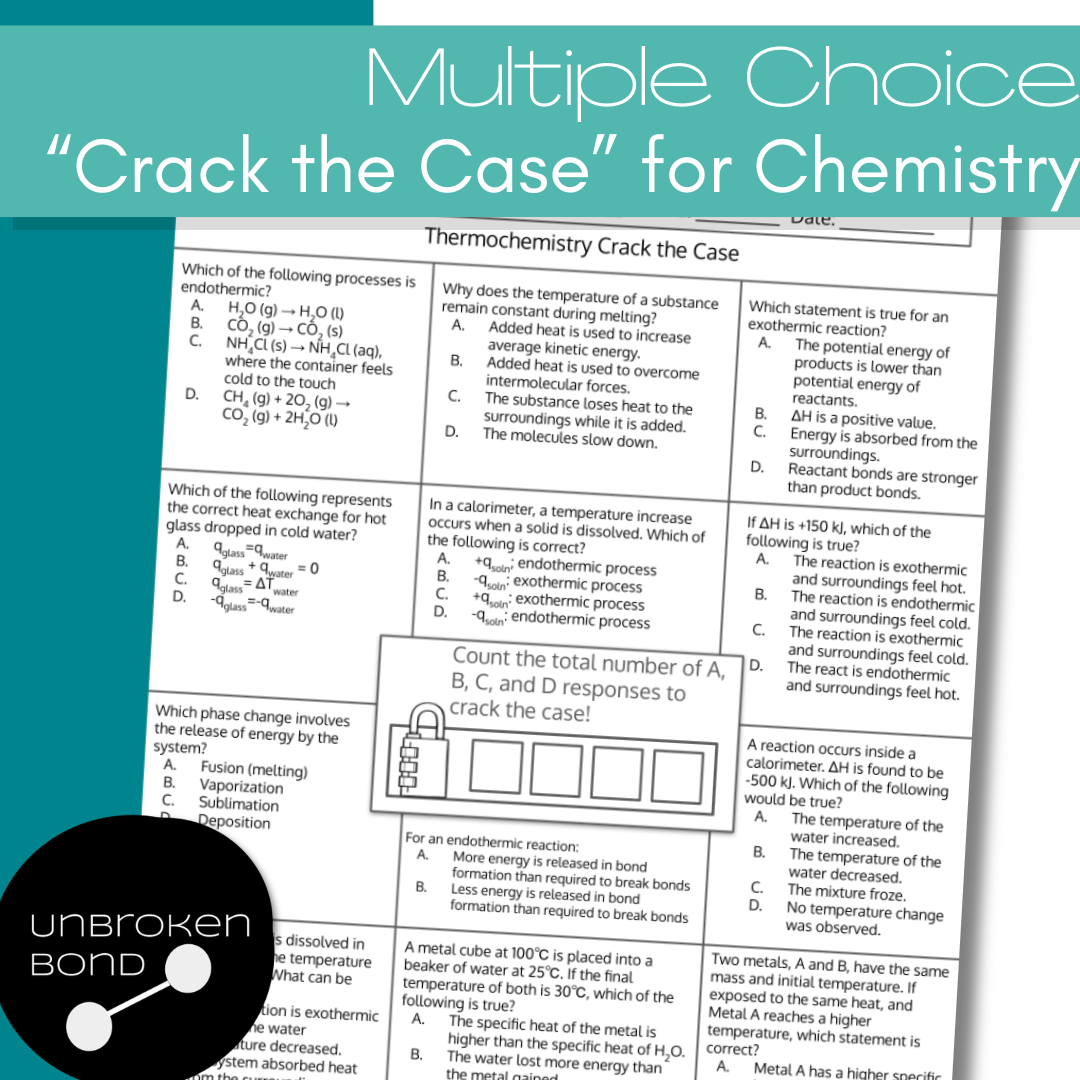
I designed a one page paper with 12 multiple choice questions. In the center of the paper, I added a lock code with four boxes. The instructions inform students to add up the total number of A, B, C, and D responses to get the code. This adds a bit of a puzzle factor to the multiple choice practice, and students were engaged in trying to determine the code.
Tips for Your Classroom
If you try this in your classroom, here are some tips I would consider:
Have students read each question and select an answer individually first. Then, students can compare with a partner. I found that this encouraged good academic discussion with my students.
Be aware that students could still get the correct code, but might not have chosen the appropriate answer for all questions. I recommend providing a key at some point or going through each question as a class once discussions have taken place.
As students are discussing, you can circulate and observe the codes they have currently. You can tell students something like “A and B are good, but C and D are not.” I found that this encouraged engagement and discussion among students.
Overall, this simple twist on multiple choice practice turned what can feel like a routine task into something much more engaging and interactive for my students. By adding a small layer of challenge and collaboration, students were more willing to stick with difficult questions, talk through their thinking, and actually care about getting to the right answer. If you’re looking for a low-prep way to make multiple choice practice more meaningful, especially in chemistry or AP Chemistry, this “crack the case” format is definitely worth trying in your classroom.
Thanks for reading! If you try this out in your classroom, let me know how it goes over on Instagram.