Spin and Cover in Chemistry: A Low Prep Partner Activity Your Students will Love
If your students see another worksheet and immediately lose motivation, you’re not alone.
As chemistry teachers, we know students need repetition. They need practice identifying reaction types. They need practice distinguishing between endothermic and exothermic processes. They need practice with balancing equations, naming compounds, and so much more.
But they don’t need more boredom.
That’s where spin and cover chemistry activities come in.
Spin and cover turns routine practice into an engaging, collaborative and low-prep partner activity that keeps students accountable and talking about chemistry. And the best part is that it doesn’t take much extra work on your end.
What is a spin and cover activity?
A spin and cover activity is a partner-based activity where students:
Spin a spinner.
Consider the prompt in the section of the wheel where the spinner lands.
Solve or identify an example that fits that prompt/category.
Cover a corresponding square on the game board with a chip.
Students continue spinning and solving until they cover a row, column, or entire board.
It’s simple. It’s structured. And it feels more like a game than a worksheet.
Why Spin and Cover Works So Well in Chemistry
It increases engagement without a ton of additional prep on your part.
Spin and cover activities make practice interactive without requiring elaborate materials. You need:
A spinner (can be digital)
A BINGO-style game board
Chips to cover squares (bingo chips, erasers, etc.)
That’s it. No stations to rotate. No complicated rules to explain. No hours of prep.
2. It builds academic conversation.
When students work in pairs, they naturally explain:
“Why is that a double-replacement?”
“Wouldn’t this be endothermic because energy is absorbed?”
“Is this combustion or just synthesis?”
That discussion is powerful. Students don’t just identify answers-they justify them. And in chemistry, reasoning matters.
3. It allows repetition without boredom.
Repetition is necessary for mastery. But traditional repetition can feel monotonous. Spin and cover activities disguise repetition as game play. Students are focused on getting five in a row, but they are really getting high-quality retrieval practice.
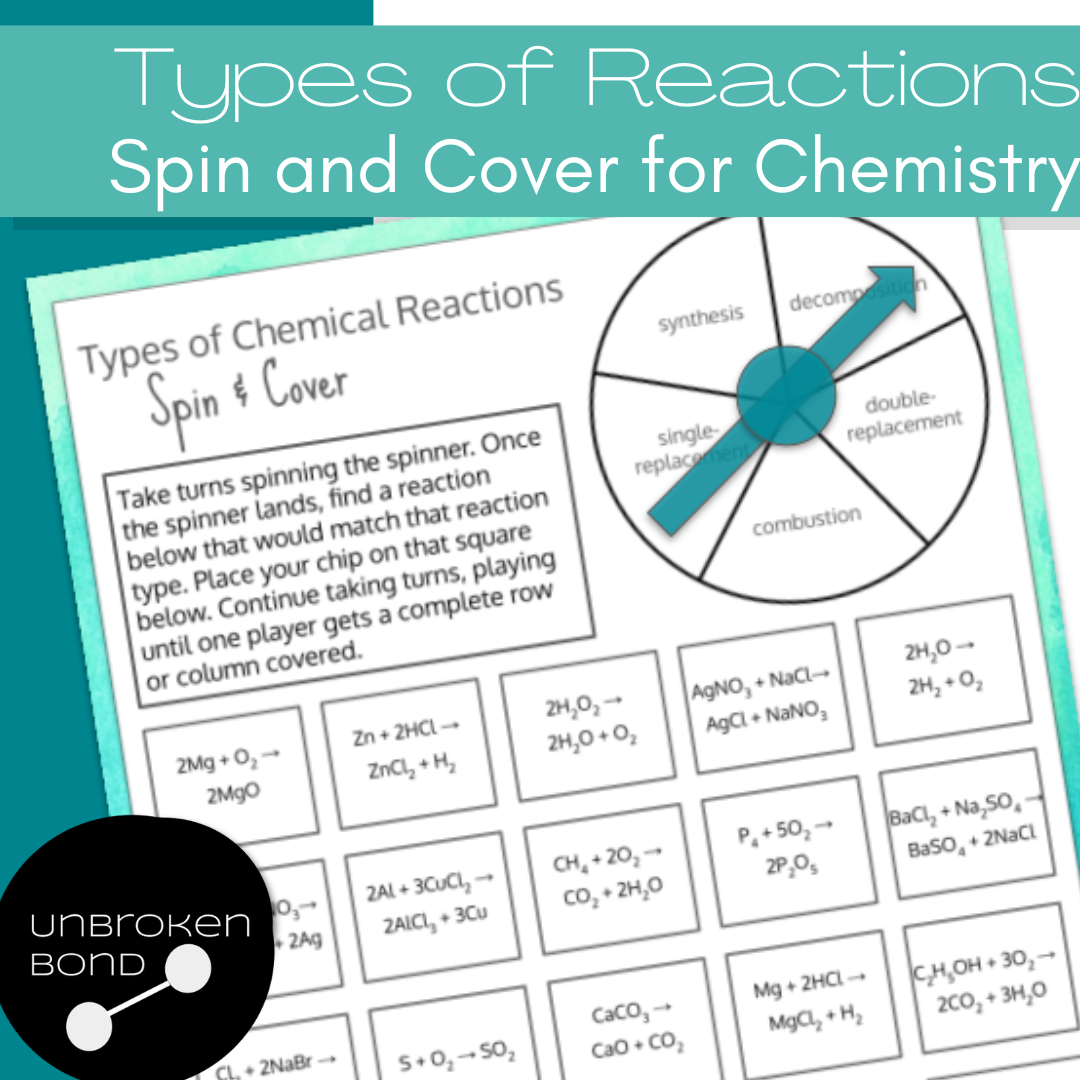
Example: Types of Chemical Reactions Spin and Cover
This activity would help students focus on identifying the following reaction types:
Synthesis reactions
Decomposition reactions
Single-replacement reactions
Double-replacement reactions
Combustion reactions
Students spin, and the spinner lands on a type of chemical reaction. They then identify a reaction in the grid below that fits that category, covering the example with a chip.
Because it’s partner-based, I heard students talking through reasoning as they paced chips on the squares. That immediate discussion can help correct errors before misconceptions stick.
How to Create Your Own Chemistry Spin and Cover Activities
If you want to make one from scratch, here’s what you need to do.
Step 1: Choose a focused skill.
Keep it targeted. Try to come up with a skill that can be categorized. Examples could be types of chemical reactions, types of bonds (covalent vs. ionic), identifying acids and bases, etc.
Step 2: Create the spinner.
Add a spinner to the worksheet. Use a circle shape in Google Slides and segment into the appropriate number of sections, or get pre-made spinner templates from TPT. For example, in my types of reactions spin and cover, my wheel has five sections, with each section in the wheel corresponding to a reaction type.
Step 3: Create the board.
Create the grid on the bottom of the worksheet. For faster games, you can create a 3x3 grid. I usually stick with a traditional 5x5 grid, so it’s more like traditional BINGO.
Each box or circle on the grid needs to be filled in with an answer/response. For example, in my types of reactions spin and cover, each square in the grid contains an example reaction. Approximately 5 of each reaction type went into the grid.
Step 4: Set clear rules.
Decide how a student will win. Do they need a complete row or column? Do they need to fill the board? Are you doing timed rounds? Clear expectations lead to smooth classroom management.
Classroom Management Steps for Spin and Cover
Here’s what works well in my classroom:
Require partners to agree before covering a space.
Circulate the room and ask each pair a “why” question.
Switch partners if a pair isn’t working.
Use mini whiteboards if students need to work something out or do a calculation.
Early finishers can play an additional game or write an additional response for a grid square.
Because the structure is simple and engaging, students stay on task and classroom management is easy.
Why Spin and Cover Fits into a Self-Checking Classroom
If you’ve been following along with my series on self-checking activities, you know I’m always looking for ways to:
Reduce grading
Increase student accountability
Build independence
Keep engagement high
Spin and cover fits beautifully into that framework. Students get immediate feedback from their partner. They correct mistakes in real time. And you spend less time collecting and grading papers. It’s a win-win.
Ready to Try Spin and Cover in Your Classroom?
If you want to start with a ready-made version, you can check out:
Identifying Types of Chemical Reactions Spin and Cover Partner Activity
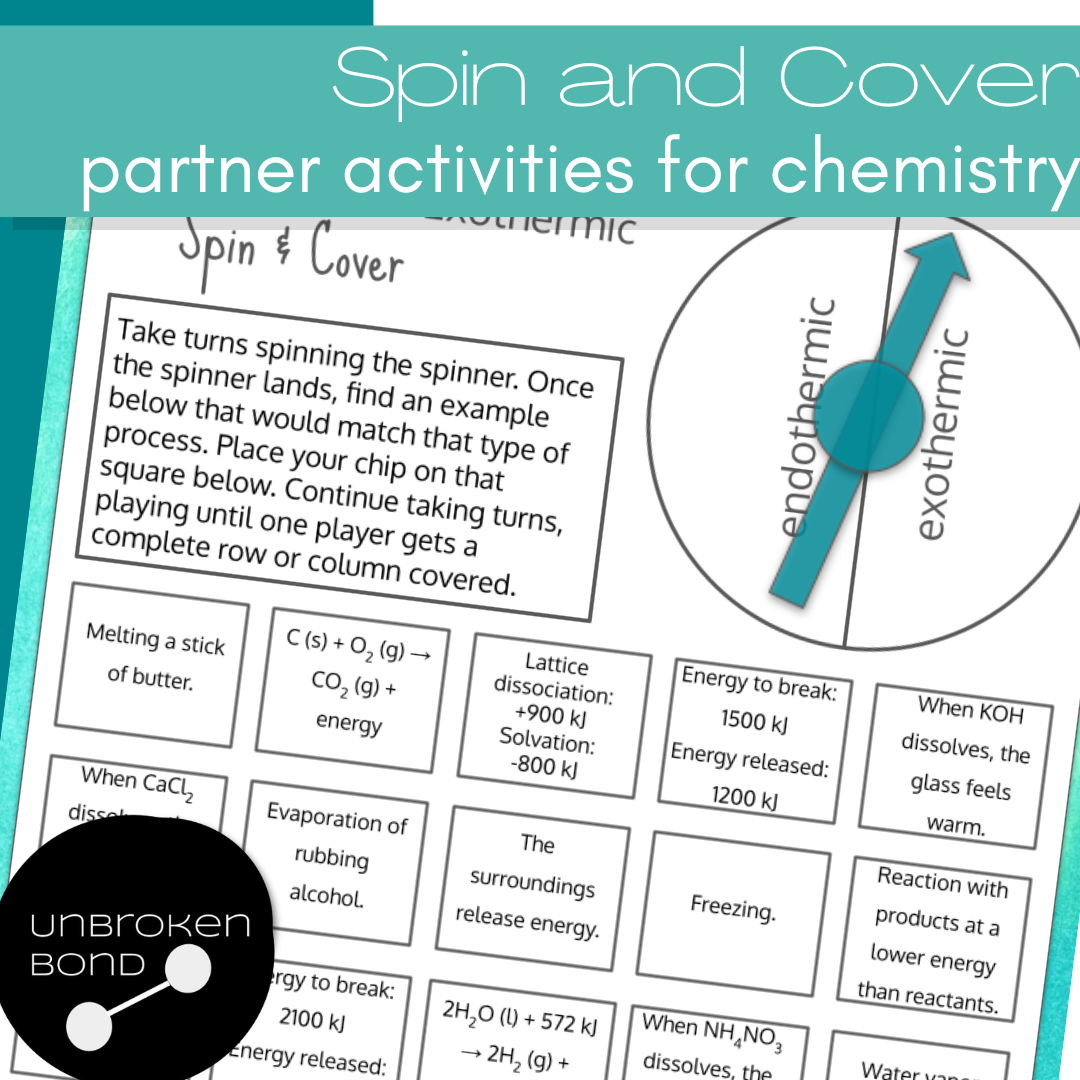
And keep an eye out for additional versions-including endothermic versus exothermic and more specific spin and cover activities coming soon.
Because chemistry practice doesn’t have to feel repetitive. It can feel interactive. It can feel collaborative. It can feel fun. And your students will learn. Thanks for reading! If you use these activities or want to in the future, let me know over on Instagram.