Looking for engaging chemistry review games that don’t require hours of prep? Whether you’re reviewing for a unit test, preparing for semester exams, or just trying to shake up your routines, games and activities can be a great way to get students practicing chemistry concepts.
But not all review games are created equal. Here are six of my favorite low-prep chemistry review games that keep students engaged while still challenging them to think.
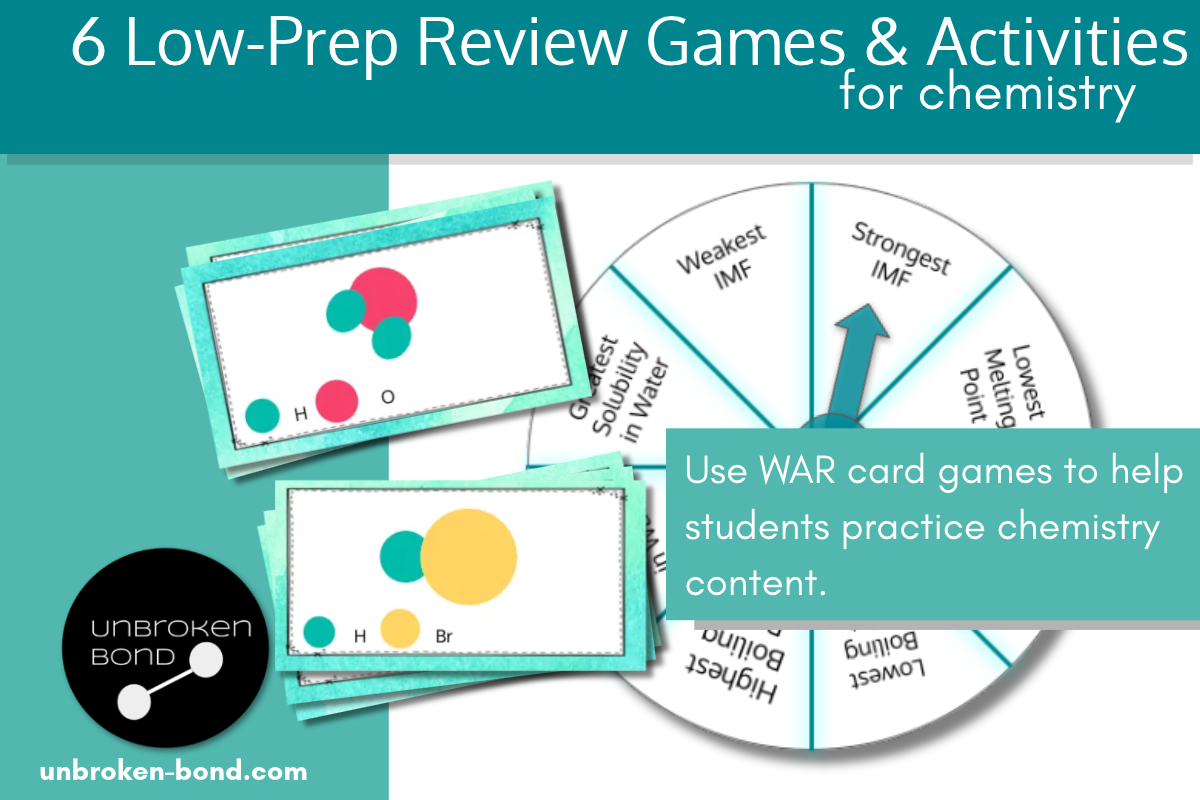
WAR Card Games
WAR isn’t just for playing cards! In chemistry, students can compare elements, molecules, or other properties to determine which card wins. For example, students might compare atomic radius, electronegativity, intermolecular forces, or pH values.
What makes this game useful is that students have to justify which card wins. They have to apply chemistry concepts.
To set up a game, you just need a set of cards for partner pairs. Students shuffle those cards, play a card each round, and determine the winner. If you want to learn more about setting up WAR card games for chemistry, check out my WAR blog post.
WAR card games work well for partner practice, review stations, or those last few minutes of class.
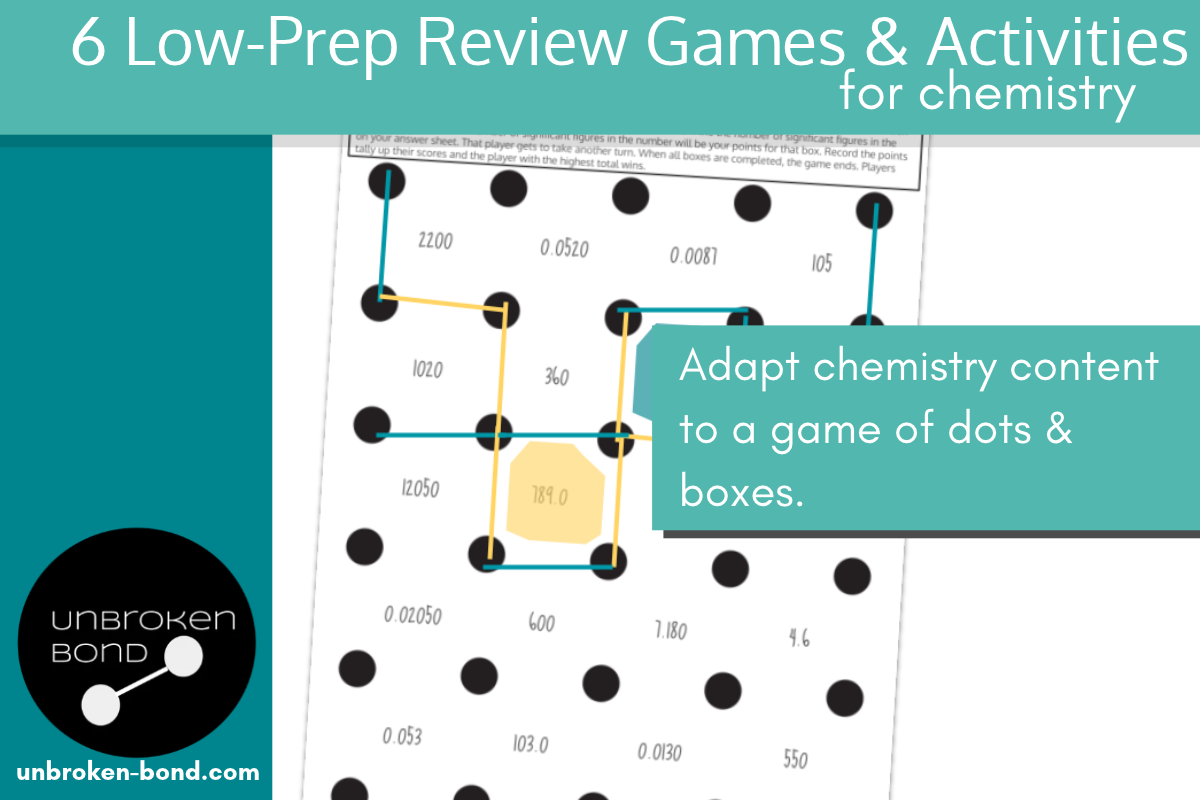
Dots & Boxes
Dots and boxes takes a familiar pencil and paper game and turns it into chemistry practice.
Students take turns drawing lines between dots. When a student completes a box, they complete the problem or question inside the box. The answer will relate to the points the student earns for that box. For example, if the game involved calculating pH or pOH, the points would be equal to the answer for the problem (pH=7.22 would mean 7.22 points for that player). Or students could identify ionic or covalent bonds, with one point if the molecule is covalent and two points if the compound is ionic.
This format works well for skills that require repeat practice, such as significant figures, pH calculations, and more. It’s an easy way to turn what might otherwise be a traditional worksheet into an interactive partner activity. If you’re interested in learning more, check out my Dots & Boxes Blog Post.
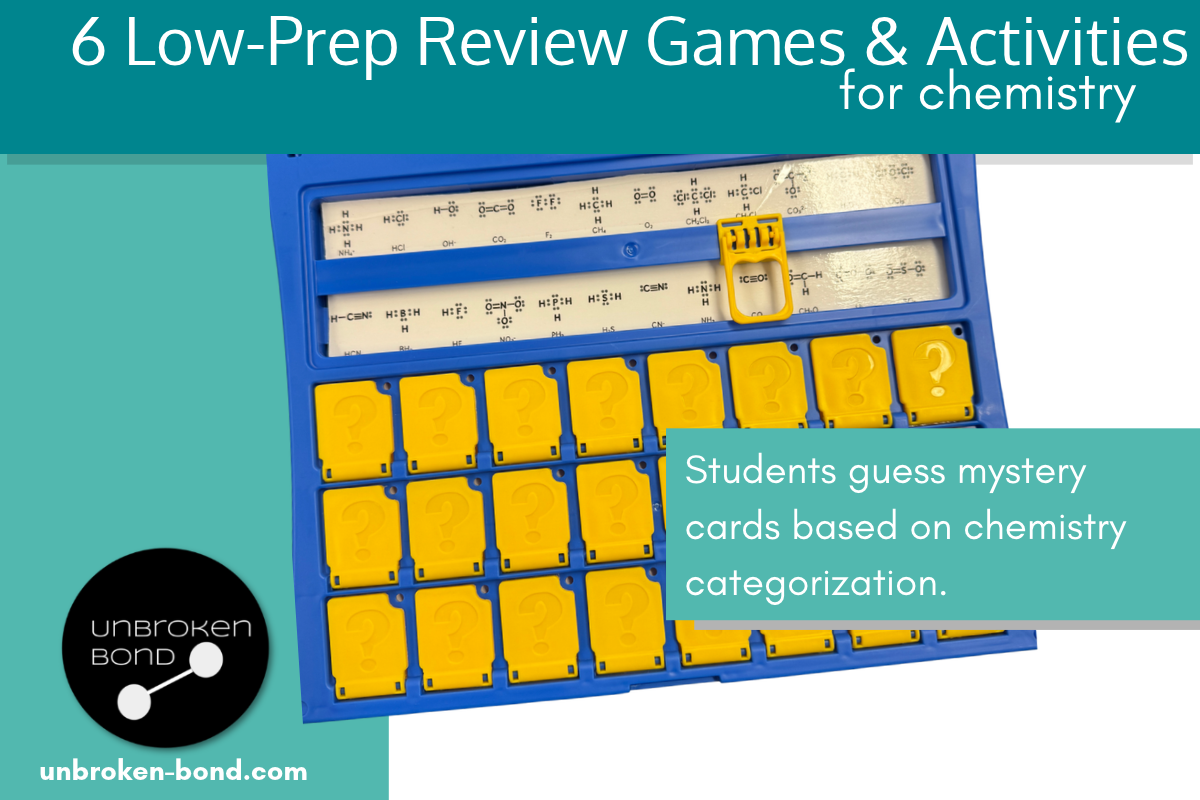
Chemistry Guess Who
Chemistry Guess Who is one of my favorite ways to encourage students to ask thoughtful questions.
Instead of guessing people, students identify elements or molecules by asking yes or no questions based on their properties. For example, students might ask:
Is your element a halogen?
Does your element have more than 20 protons?
Is your molecule linear?
Students have to think carefully about the questions they ask, making this a great activity for chemistry classification and scientific reasoning.
If you don’t want traditional (physical) game boards, you could easily adapt a worksheet of questions into a grid for students to use in a game of Guess Who instead. If you want to read more about Guess Who, check out this blog post.
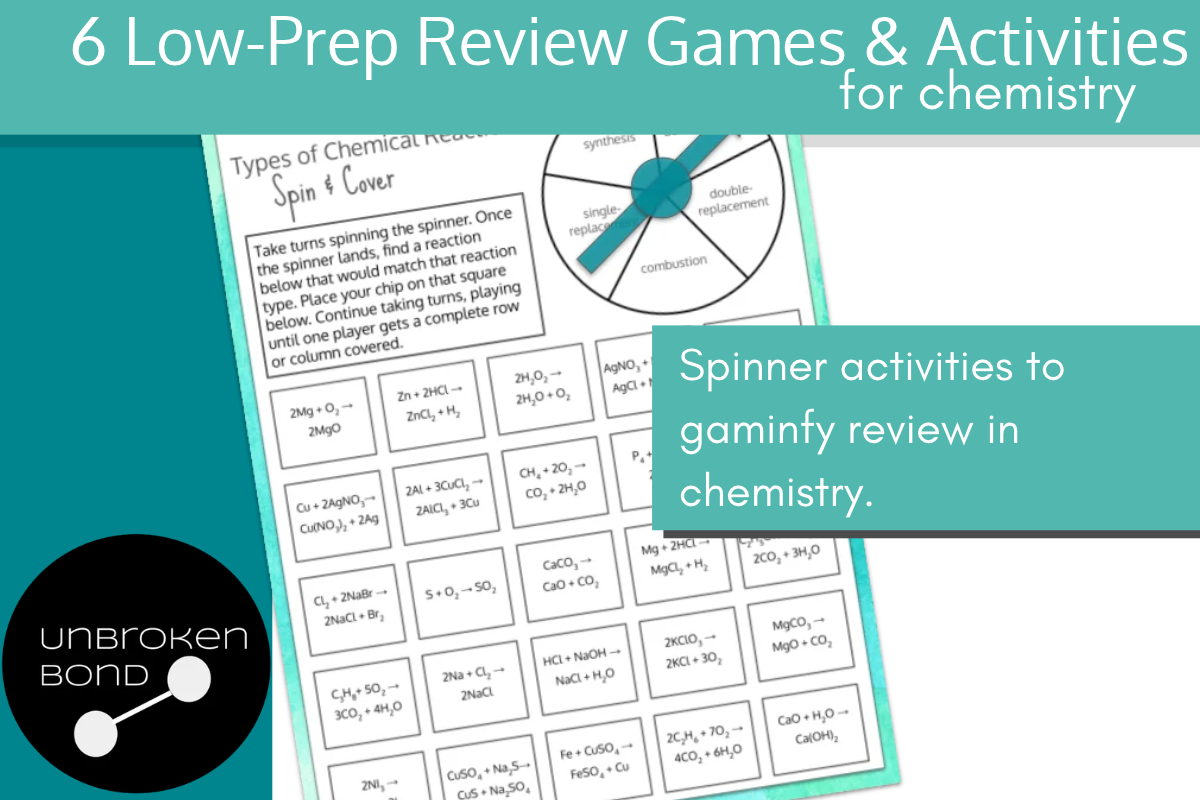
Chemistry Spinner Games
Sometimes all it takes to make practice more engaging is adding a spinner!
Spinner games introduce an element of chance while keeping the focus on chemistry. Depending on the format, students might spin to generate a problem, identify a reaction type, compare substances, or solve a calculation.
I especially like spinners because students can complete multiple rounds of practice without every round feeling exactly the same. These activities work well for partners, small groups or for independent review. I’ve got a few spinner related blog posts, but I’d start with Spin & Cover if you’re interested in learning more.
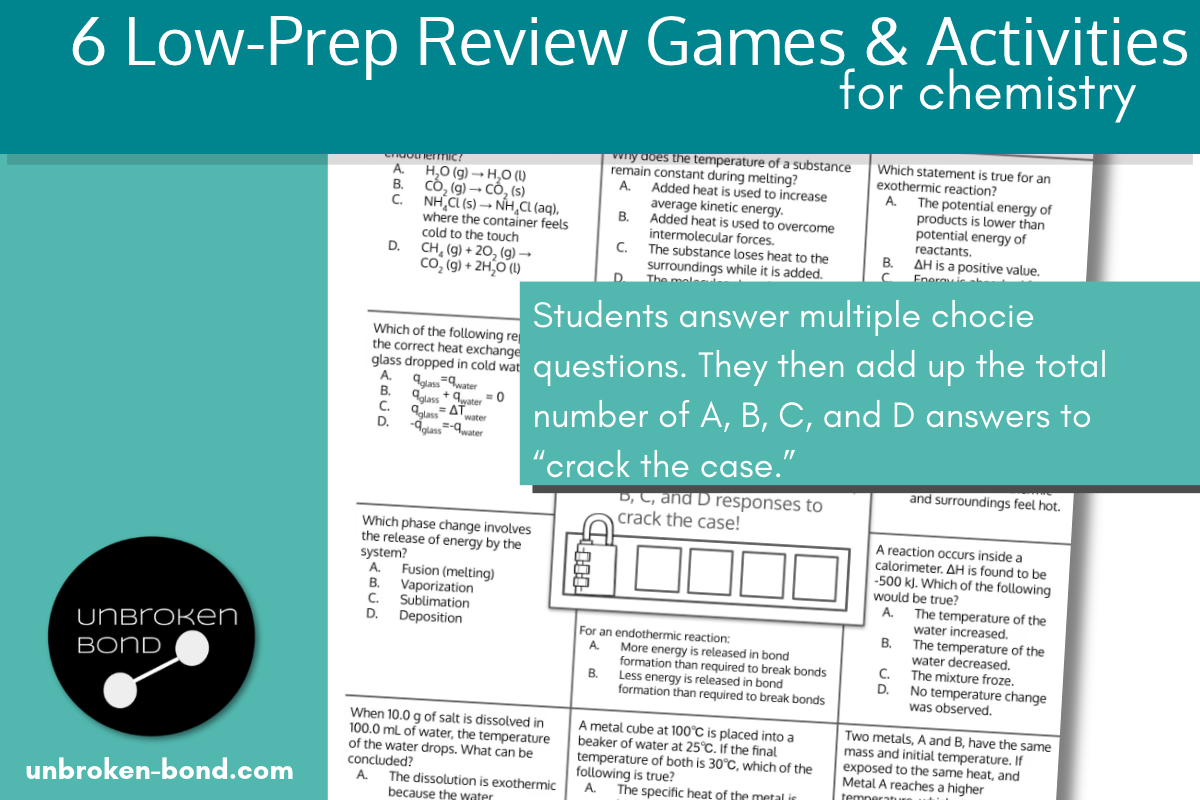
Crack the Case
If your students enjoy solving mysteries, Crack the Case activities are a fun way to make multiple choice review or calculation review more interesting. Students answer chemistry questions to collect clues that help them solve a mystery.
The questions can still require higher-level thinking, calculations, or application of concepts. The mystery simply gives students an additional reason to keep working.
For a multiple choice option, provide students with a series of questions. Once answered, students add up all A, B, C, and D answers, which turns into a 4-digit number lock. I’ve got a whole blog post on multiple choice crack the case.
For calculations or other questions involving numbers, the number answer itself is the code to the “lock.” If you want to have students complete more than one, you can use multiple “locks” in a logic puzzle at the end.
I like this format for unit reviews because students stay focused on completing the challenge while getting meaningful practice with chemistry content.
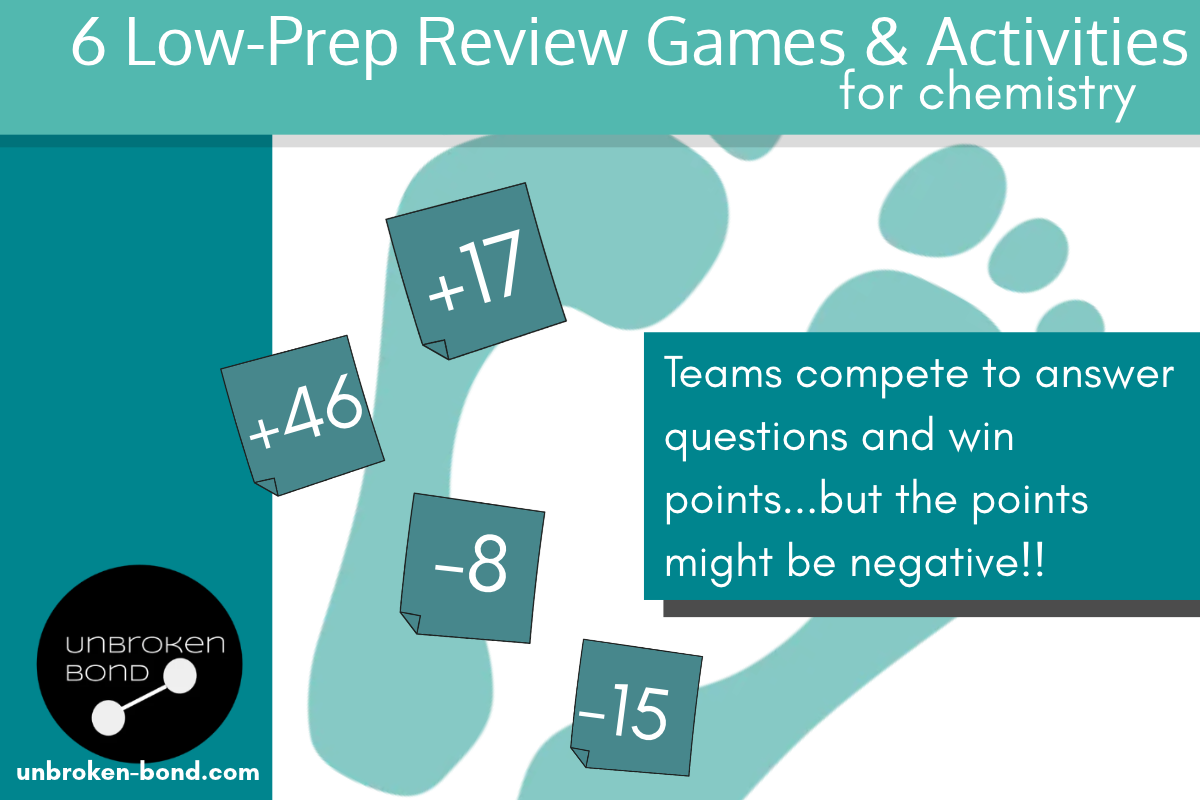
Stinky Feet
Stinky feet is a classroom review game that adds a little unpredictability to traditional question and answer review.
Students work in teams to answer questions and earn points, but the point values are hidden and can be positive or negative! Because teams don’t know how many points they’ll earn, the game stays competitive, even when one team has answered more questions correctly. The winning team could be the team with the most points, the team with the lowest points, or the team with points closest to a certain number.
One of the best things about Stinky Feet is that you can use questions you already have. Think questions on the projector screen or questions on already-made task cards. You don’t need to create an entirely new set of review materials. Just add point-value cards (or sticky notes) and you are all set! Want to try it? Check out my Stinky Feet Classroom Game Blog Post for more details.
Making Chemistry Review More Meaningful
Review games don’t have to be complicated to be effective. Whether students are comparing properties in WAR, asking questions in Guess Who, or solving a mystery in Crack the Case, the goal is the same. Get students actively thinking about chemistry.
One simple way to make any review game more meaningful is to ask students to explain their answers. Even a quick conversation about why and answer is correct can turn a fun activity into a valuable learning experience.
And the best part? Many of these chemistry review activities can be reused throughout the year with different chemistry topics.
What are your favorite review games and activities? Let me know over on Instagram. Thanks for reading! Happy teaching!